Why Vein Practices Are Rethinking Clinical Photography
Tue Jul 14 2026
Your vein results are excellent. Your documentation may be costing you conversions, efficiency, and revenue. Here's what the best vein practices are doing differently.
Your Vein Results Are Excellent. Your Documentation Probably Isn't.
Every vein physician knows the feeling. You've just completed a technically excellent sclerotherapy session — clear spider veins, happy patient, textbook outcome. Two weeks later, they're back for their follow-up. You pull up the before photo. It's slightly overexposed, taken at a different distance than today's image, the patient is standing at a different angle, and the background is the storage cabinet on the far wall of your procedure room.
The result looks great in real life. In the photo comparison, it looks ambiguous at best.
You know the treatment worked. The patient knows the treatment worked. But the before-and-after — the most powerful clinical documentation and marketing tool available to a vein practice — is failing to tell that story.
This is not a small problem. It's the central clinical photography problem in vein medicine today. And most practices are solving it with tools that were never designed for the job.
Vein Medicine Is Visual Medicine
Varicose veins. Spider veins. Chronic venous insufficiency. Reticular veins. Every condition you treat presents visually. Every outcome you deliver is visible. The entire value of what you do — reducing pain, improving appearance, restoring confidence — can be shown in a photograph.
This makes vein medicine uniquely dependent on clinical photography. Not as a nice-to-have. As a clinical and business essential.
Before-and-after photos drive consultation conversions. They build trust during the patient encounter. They document medical necessity for insurance pre-authorization. They power your website, your social media, and your patient referrals. A patient who receives a clear, professional before-and-after of their leg vein clearance and shares it with a friend is worth $1,500 to $3,000 in referred procedure revenue.
And yet most vein practices are documenting all of this with tools that undermine it at every step.
The Four Problems Most Vein Practices Share
1. Personal devices and HIPAA liability.
It happens in nearly every practice. An MA photographs a patient's legs on their personal iPhone. The image lands in iCloud. It syncs to Google Photos. It's backed up to a family iPad at home. Every one of those touchpoints is a potential HIPAA violation. A single audit finding in this area can cost a practice six figures in fines and remediation. The convenience of the iPhone is real. The liability is realer.
2. Dedicated hardware that costs too much and delivers too little.
Many vein practices invested in dedicated clinical photography hardware — systems like FotoFinder — when they were building out their aesthetic offering. Those systems had a role. But they came with capital costs of $15,000 to $50,000, require a dedicated photo room, and depend on laser-range devices and manual positioning that still produce inconsistent results when different MAs are operating them. A five-millimeter difference in camera distance produces a before-and-after that doesn't line up. A slightly different angle produces one that looks like a different patient entirely.
And when the hardware ages out, the upgrade conversation is a significant capital event — at exactly the moment a better alternative exists.
3. The photo room bottleneck.
A fixed photography setup means one room, one workflow, one lane. Patients queue. MAs wait. The provider's schedule backs up. For a high-volume vein practice seeing 15 to 25 patients per day, the photo room is often the single largest efficiency constraint in the clinic — not because photography is slow, but because it's fixed in space and staffing when it doesn't have to be.
4. No way to share results with patients.
Ask yourself: how do you currently send a before-and-after photo to a patient who wants to show their results to a spouse or friend?
Most vein practices print on photo paper. At meaningful per-print cost, with results that look mediocre on a smartphone screen and can't be shared digitally. Patients who leave with a printed 4x6 don't share it. Patients who leave with a crisp digital before-and-after on their phone do. That sharing is organic referral marketing. It costs you nothing. And you're currently leaving it behind at the printer.
What Standardized Vein Photography Actually Requires
The clinical photography standard for a vein practice is straightforward — but it demands consistency that manual workflows can't reliably deliver.
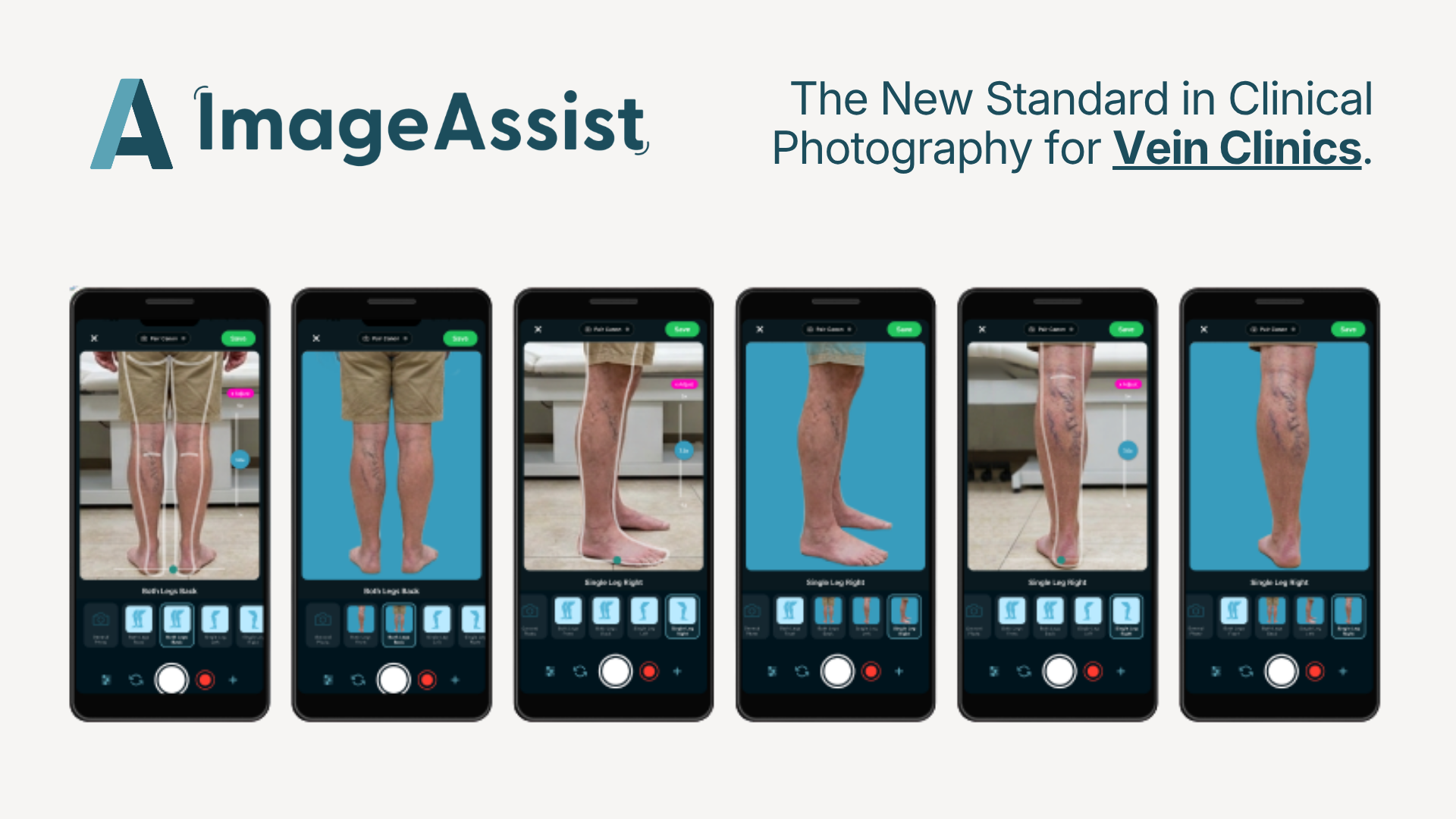
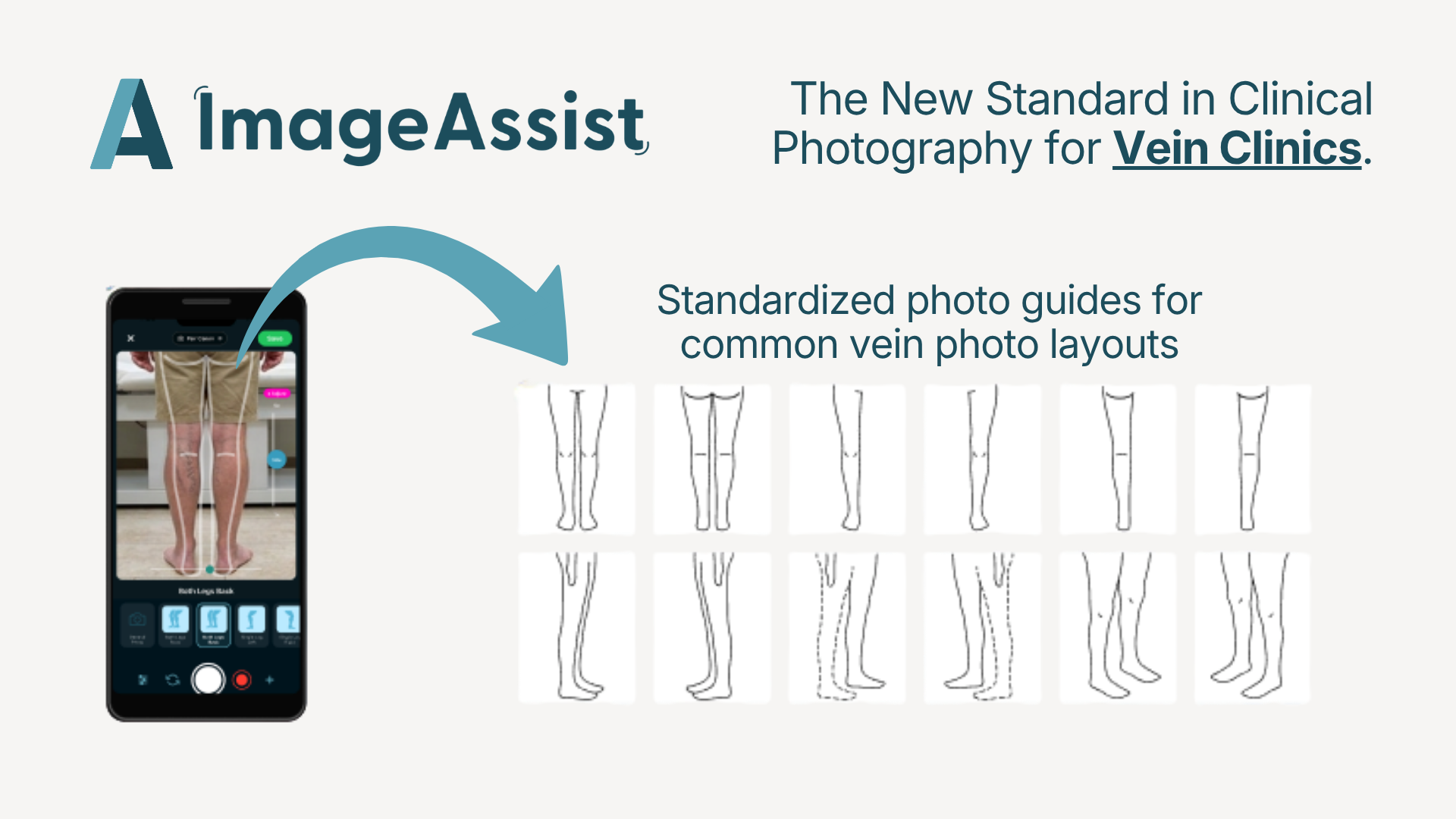
For leg vein documentation, you need bilateral views in at least four positions: anterior, 45-degree medial oblique, lateral, and posterior. Both legs, both sessions, every time. For hand vein procedures, dorsal hand views bilaterally. For any returning patient, the follow-up photos need to match the baseline in position, distance, angle, and lighting — not approximately, but exactly.
That's what makes a before-and-after actually useful. Not just visually pleasing. Clinically defensible, insurance-documentable, and genuinely persuasive to a patient sitting in your consultation room deciding whether to proceed with treatment.
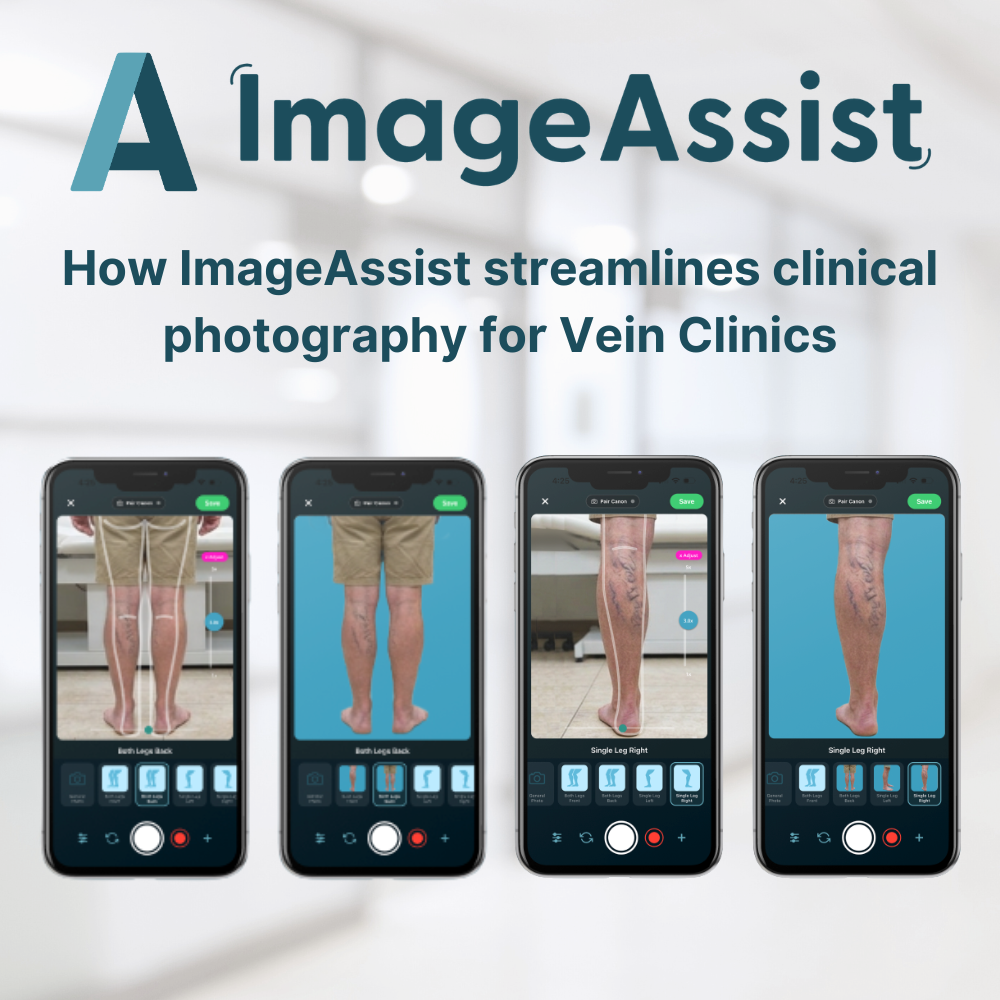
Achieving that consistency requires smart positioning guides — not a laser range device that depends on an MA reading a number correctly, but a digital overlay that turns green when the position is right. It requires the same standardized guides for every provider, every MA, every location.
And it requires a workflow that can happen anywhere in the clinic, not just in one dedicated room.
What It's Worth
The practices that get clinical photography right in vein medicine see measurable business impact. Not marginal improvement — significant movement.
Consultation-to-procedure conversion rates improve materially when physicians can show patients organized before-and-after albums by procedure type and result during the consultation itself. Practices that have made this shift report conversions moving from the 60-percent range to well above 80 percent on elective vein procedures.
Staff time spent on clinical photography drops by more than half when the workflow is mobile and guided rather than fixed and manual. For a practice with two MAs supporting 20 patients per day, that time savings more than covers the annual cost of a modern photography platform in the first month alone.
And for the practices currently facing a FotoFinder hardware upgrade decision, the math is especially simple. A modern clinical photography platform runs on the iPads already in your clinic, requires no capital expense, and costs a fraction of hardware maintenance annually. The three-year cost difference between upgrading dedicated hardware and switching to a software-based platform is typically between $13,000 and $45,000 in the practice's favor.
The Practices Getting This Right Are Pulling Away
Clinical photography is not a glamorous operational problem. It's not the first thing on a vein physician's mind when they think about growing their practice or improving patient outcomes.
But it sits underneath nearly everything that matters in a vein practice: patient trust, consultation conversions, insurance documentation, marketing assets, and staff efficiency. Practices that solve it well have a compounding advantage over practices that don't — in every patient encounter, every consultation, every referral.
The good news is that solving it is no longer expensive or complex. The tools exist. The workflow is simple. The ROI is clear.
Your results deserve documentation that does them justice.
ImageAssist is a HIPAA-compliant clinical photography platform built for vein practices — with standardized leg guides, ghost-overlay before/afters, and instant patient sharing. Incubated at Vanderbilt University Medical Center and backed by the American Society of Plastic Surgeons.